
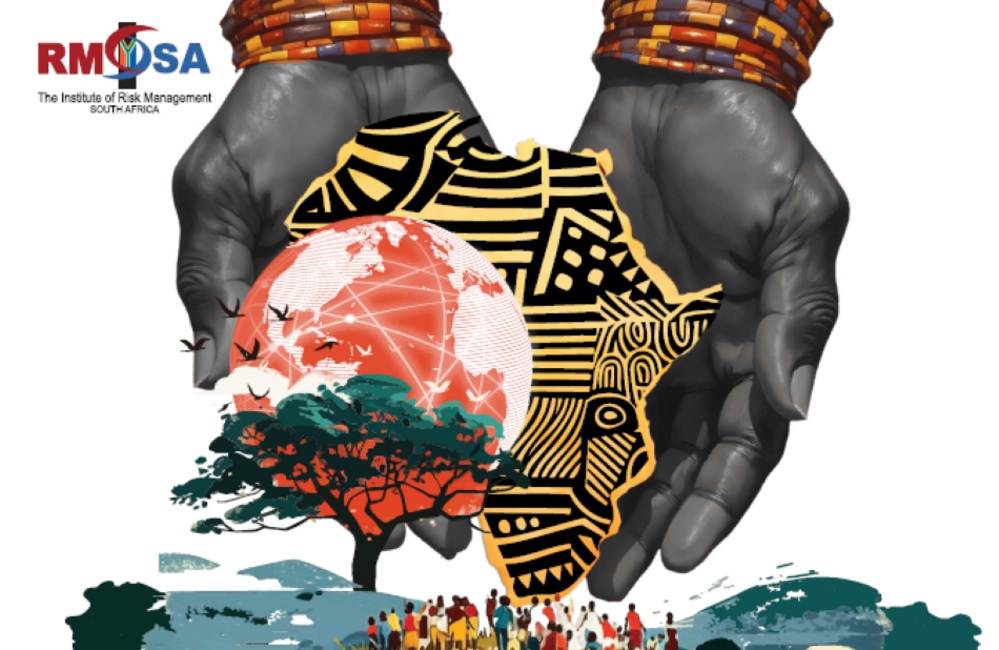
Governance and leadership failure emerges as Southern Africa's greatest risk multiplier
Johannesburg - The Institute of Risk Management South Africa (IRMSA) has launched its 2026/27 IRMSA Risk Report, warning that Southern Africa has reached a critical point where the region's greatest challenge is no longer the existence of multiple risks, but the way those risks are increasingly interconnected, reinforcing one another and compounding their impact.
Now in its 12th edition, the IRMSA Risk Report has become one of Africa's leading assessments of emerging and systemic risks. This year's report moves beyond identifying the region's top risks to examining the relationships between them, arguing that today's disruptions rarely occur in isolation. Instead, governance failures, economic pressures, political uncertainty, infrastructure constraints, climate impacts, cyber threats, organised crime, and social instability increasingly interact as part of a single interconnected ecosystem.
At the centre of this ecosystem sits governance and leadership failure, ranked as the highest risk in the 2026/27 report.
Importantly, the report concludes that governance and leadership failure should not be viewed simply as another risk category. Rather, it has become the systemic condition through which many of Southern Africa's most pressing challenges are created, amplified, or allowed to persist.
Weak governance contributes to deteriorating infrastructure, weakens economic confidence, enables corruption and organised crime, undermines institutional capability, delays service delivery, erodes public trust and reduces society's ability to respond effectively to crises. Conversely, strengthening governance has the potential to improve resilience across every sector of society.
The report argues that many of the challenges confronting South Africa today should not be viewed as isolated incidents, but as symptoms of deeper systemic weaknesses. As seen in the recent immigration unrests, economic hardship can fuel social frustration. Social frustration can manifest in public protest and instability. Business operations become disrupted, supply chains are affected, security resources are diverted, investor confidence declines and pressure on public institutions intensifies. What begins as one challenge rapidly cascades into many others.
This compounding effect lies at the heart of the report's central message: risk no longer travels alone.
The 2026/27 report is themed Umphakathi Vuka: Awakening the Forest, using the metaphor of a living forest to illustrate the interconnected nature of modern risk. Just as the health of a forest depends on the strength of its root system and the relationships between every living component, the resilience of nations, organisations and communities depends on the quality of governance, leadership, and collective action.
Speaking at the launch, IRMSA Chief Executive Officer Yvonne Mothibi said the findings represent a call for a fundamental shift in leadership thinking.
"Governance and leadership failure is not simply the highest-ranked risk in this year's report. It is the risk that enables many of the others to emerge, persist and compound. Infrastructure failure, economic instability, declining public trust, corruption, cyber vulnerability and social instability often share a common thread, the quality of leadership, governance and execution."
Mothibi said the report challenges leaders to move beyond managing risks in isolation.
"Too often we respond to the visible symptoms of disruption without addressing the underlying systemic causes. Resilience is not built by responding better to crises alone; it is built by strengthening the governance, institutions and leadership that prevent risks from escalating in the first place."
The report identifies the South Africa's highest-ranked risks as governance and leadership failure, economic and macroeconomic instability, political instability, infrastructure failure, unemployment and inequality, climate resilience failure, corruption and organised crime, cyber risk and digital disruption, water insecurity, and electricity and energy constraints.
However, IRMSA emphasises that the report is not intended as a catalogue of threats. Every risk identified also presents an opportunity for renewal. Stronger governance can restore confidence. Infrastructure investment can unlock economic growth. Climate adaptation can stimulate innovation. Digital transformation can strengthen resilience. Ethical leadership can rebuild trust.
The report also introduces practical future scenarios to help boards, executives and policymakers understand how interconnected risks may evolve over time and how organisations can build resilience before crises emerge.
The report calls on leaders across business, government, academia, and civil society to embrace a more integrated approach to decision-making, one that recognises the inseparable relationship between governance, strategy, risk, resilience, and sustainable development.
"The future of South Africa will not be determined solely by the risks we face," said Mothibi.
"It will be determined by the quality of leadership we demonstrate in responding to them. Every decision we make either strengthens or weakens the resilience of the ecosystem we all share. Building resilience is therefore no longer the responsibility of risk professionals alone, it is a collective leadership imperative."
The 2026/27 IRMSA Risk Report is available at: https://www.irmsariskreport.co.za/report/






 Insurance Biz proudly displays the "FAIR" stamp of the Press Council of South Africa, indicating our commitment to adhere to the Code of Ethics for Print and online media which prescribes that our reportage is truthful, accurate and fair. Should you wish to lodge a complaint about our news coverage, please lodge a complaint on the Press Council's website, www.presscouncil.org.za or email the complaint to enquiries@ombudsman.org.za. Contact the Press Council on 011 4843612.
Leave a Comment