

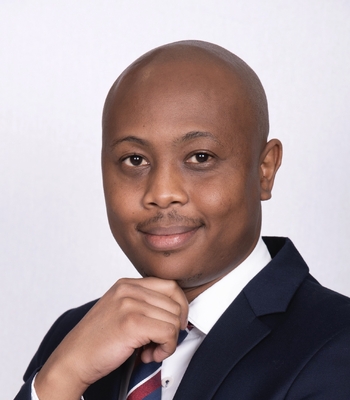
Eight Leadership Questions for Linda Seroka, Chief Executive, ECIC
A woman who can earn, own, invest, insure and build has choices - and choices change the trajectory of families and communities. That is why representation at the top matters, but it cannot be the finish line. Our leadership must translate into institutions, markets and systems that work better for women who may never sit in our boardrooms.
I honour the women before us by asking a simple question of my own leadership: because I was here, whose possibilities became bigger?
Q1 | Where It Began
Leadership began for me long before I had a title. The defining moments were the ones in which I was entrusted with outcomes bigger than my job description - bringing people and teams together, solving difficult problems and taking responsibility when the answer was not obvious.
Those early experiences taught me two this I still carry: I have come to see leadership less as the exercise of a position and more as responsibility for people, outcomes, and the institution entrusted to you. The chair may belong to you for a reason, what matters most is how well leave the people and the institution in your care. Leadership is keeping a hand on the reality of today and the other on possibility , then helping people move from one to the other . I also learned that competence earns you an invitation, while character decides the footprint you leave once you arrive.
Over time, my responsibilities grew, but the principles did not change. I try to lead with high standards and humanity together: be clear about the destination, create room for people to contribute, and never ask a team to carry a burden I am unwilling to carry with them.
Q2 | The First 100 Days
I assumed the role of CEO of ECIC on 1 June 2026. I entered with a very clear conviction: ECIC could not simply be an institution that processes export credit insurance. It had to become an institution that actively enables South African exporters to win in the continent and beyond.
So the first 100 days were about creating momentum around one idea – our aim was to ensure that viable South African export opportunities are not lost where ECIC and its partners can unlock the necessary financing and risk capacity. i.e. where an export opportunity is sound, our job is to help build the financial bridge that gets it over line. That meant listening deeply to the management team on what is working well and what requires improvements to make this possible; strengthening collaboration with business partners, and challenging ourselves to move with greater urgency.
The ambition is larger than a number on a scorecard. When a South African company wins a contract in Africa, factories can stay open, jobs can be created and supply chains can grow. My first 100 days were about reconnecting our daily work to that consequence —aligning our day to day work to our strategic objectives and mandate in order to turn ECIC’s balance sheet into possibility.
Q3 | Leading Through Pressure - Present Day
The challenge I wrestle with most is the gap between South Africa’s export potential, financing and the speed at which we convert that potential into transactions, investment and jobs.
Africa is growing, infrastructure needs are enormous and South African businesses have capabilities the continent needs. Yet exporters can still encounter fragmented financing, political and commercial risk, regulatory complexity and institutions working sequentially rather than together. The difficult leadership question is: how do we make the system move at the speed of the opportunity?
For ECIC, that means becoming more than an insurer of risk. We must be a convener of capital, banks, government, exporters and African partners. We have to use partnerships and risk-sharing so that our balance sheet is not the limit of our ambition.
Pressure, in that context, is useful. It reminds us that institutional comfort has a cost. Every viable transaction we fail to enable may represent jobs, industrial capacity and African opportunity that went elsewhere.
Q4 | The Cost of Leading
The most expensive currency in leadership is not money. It is time - particularly time you cannot recover with the people you love.
As a mother and a CEO, there are moments when two important worlds need me at exactly the same time. I have missed moments I would have preferred to be present for, carried work into family time, and felt the familiar guilt of wondering whether giving fully to one part of my life means taking something from another.
I no longer try to make peace with that by pretending there is perfect balance. I make peace with it through presence and purpose. When I am with my children, I try to be truly there – asks what made their day special and listen with purpose; review homework and learn that which I missed on in my early learning days. I want them to understand why the work matters — that their mother is helping build something larger than herself.
I also want my children to learn that professional aspirations and devotion to the people you love can coexist. A meaningful life may require choices, but it should never require us to disappear from the lives we are working so hard to improve.
Q5 | Being Underestimated
Yes. There have been rooms in which assumptions arrived before I did - about age, gender, style, or whether being warm and approachable meant I would be less decisive or lack resolve.
Earlier in my career, being underestimated made me feel I had to prove myself immediately: know more, work harder, speak faster and leave no room for doubt. With time, I learned a more powerful response. You do not have to spend your energy fighting every assumption. You can let the quality of your thinking, the consistency of your decisions and the results you create do the arguing for you.
It changed how I lead because I am now very conscious of who may be invisible in a room. I watch for the person whose voice has not yet been heard, whose capability may be hidden behind someone else’s assumptions.
Being underestimated taught me not to shrink - but it also taught me not to reproduce the experience for others. Leadership should notice what someone can becomes, not only what they have already proved.
Q6 | Insurance, Made Personal
My most powerful experience of insurance is professional, but it is deeply human. In export credit insurance we often discuss transactions in millions or billions, sovereign risk, tenors and credit structures. Behind those words are people.
A large export transaction can support a factory, a network of suppliers, engineers, artisans and families whose livelihoods depend on an order being won and paid. When risk cannot be carried, financing may not happen; when financing does not happen, the transaction can disappear. Good insurance can therefore be the difference between an opportunity remaining on paper and becoming real economic activity.
That has changed the way I see our mandate. A policy is not the product; confidence is. We give an exporter and a financier the confidence to go where they might otherwise not go.
And this is equally important for households. Insurance at its best protects dignity: it prevents one unexpected event from erasing years of progress. We must always remember behind every policy is a person whose life can change by where that protection works or not.
Q7 | The Advice You Needed
I would tell my younger self: do not make someone else’s approval the condition for becoming who you know you can be. Trust your capacity and step into the responsibility.
Early in our careers, many of us believe confidence will arrive after one more qualification, one more promotion, one more person validates us. But leadership rarely arrives after you feel completely ready. Often the opportunity comes first, and you grow into its size by stepping forward.
I would also tell her that humility requires one to leave their ego at the door, not their stature. You can be teachable and still know your value. You can listen deeply and still have a point of view. You can be kind and still make hard decisions.
That advice still matters to me because every new level of leadership creates a new edge of uncertainty. The question is no longer, “Am I ready?” It is, “What does this moment require of me?” Then I try to become that - courageously, quickly and without apology.
Q8 | One Book I Would Recommend
Viktor Frankl’s *Man’s Search for Meaning*.





 Insurance Biz proudly displays the "FAIR" stamp of the Press Council of South Africa, indicating our commitment to adhere to the Code of Ethics for Print and online media which prescribes that our reportage is truthful, accurate and fair. Should you wish to lodge a complaint about our news coverage, please lodge a complaint on the Press Council's website, www.presscouncil.org.za or email the complaint to enquiries@ombudsman.org.za. Contact the Press Council on 011 4843612.
Leave a Comment